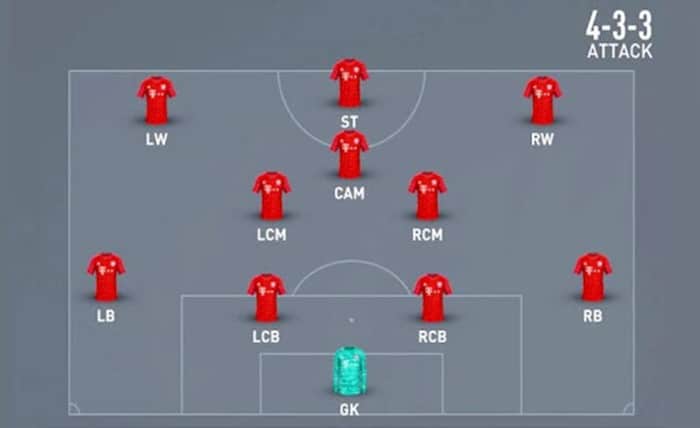
Popular football formations are the foundation that allows coaches to position players, control space, and develop a playing style suited to each opponent. From the attack-minded 4-3-3 to the balanced 4-2-3-1 and flexible 3-5-2, each system offers different ways to build attacks and organize play. When following tructiepbongda Xoilac, fans can observe not only the action but also how teams adjust their structures during different phases of a match.
What Is a Football Formation?
A football formation is the arrangement of players on the pitch, usually represented by numbers such as 4-3-3, 4-4-2, 4-2-3-1, or 3-5-2. The goalkeeper is not included in the numerical sequence, so the first number typically represents the defenders, followed by the midfielders and then the forwards.
However, a formation on paper only reflects the starting structure. In modern football, players constantly change positions depending on whether their team has possession, presses the opposition, or defends. A team that starts in a 4-3-3 can shift into a 3-2-5 when attacking or a 4-1-4-1 when dropping back to protect its goal.
Following matches through Xoilac Z can therefore become more interesting when viewers understand these positional movements instead of focusing solely on the player with the ball.
Popular Football Formations Used Today
Among the popular football formations, the 4-3-3 is highly regarded for its ability to create width and passing triangles in midfield. The basic system consists of four defenders, three midfielders, and three attacking players. Depending on how the midfield is organized, a coach can use one holding midfielder and two number eights or adjust their roles to improve possession.
When watching matches on Xôi Lạc Z, fans can pay attention to the positions of the two full-backs. If they push forward, the other players must adjust to ensure that the team does not become unbalanced when the opposition launches a counterattack.
The 4-2-3-1 formation balances defensive solidity and attacking options.
The 4-2-3-1, meanwhile, emphasizes defensive stability with two central midfielders positioned in front of the back line. Ahead of them are three attacking midfielders supporting a lone striker. This structure allows a team to protect the central areas while maintaining enough players to build attacks.
The 4-4-2 is a traditional system featuring four defenders, four midfielders, and two strikers. The distances between the lines are relatively clear, making it suitable for compact defensive organization and direct attacking play. On Xoi Lac TV, observing how the two strikers move can help viewers understand how a team using 4-4-2 applies pressure to the opposition’s defense.
How Does the 3-5-2 Formation Create a Difference?
The 3-5-2 formation uses three center-backs, five midfield players, and two forwards. Its key feature lies in the two wing-backs, who must contribute to attacks while also tracking back to defend.
When the team has possession, the two wing-backs can push forward, creating a structure resembling 3-3-4 or 3-2-5. When possession is lost, they quickly retreat to form a five-player defensive line. This ability to transition between attacking and defensive phases makes the 3-5-2 one of the popular football formations for teams with strong center-backs and physically capable wing-backs.
Viewers following tructiepbongda Xoilac through Xôi Lạc TV can watch the spaces behind the two wing-backs. These areas are often targeted by opponents when the team is slow to transition between attacking and defending.
Why Is There No Perfect Formation for Every Team?
Tactical effectiveness depends heavily on the characteristics of the players. A team with fast wingers may get the most out of a 4-3-3, while a team with two forwards who combine effectively may be better suited to a 4-4-2 or 3-5-2.
Formations must also change according to the opposition and the course of the match. When a goal is needed, a coach may push more players forward. When protecting a lead, a team will often reduce the gaps between its lines to limit the spaces the opposition can exploit.
Therefore, when following tỷ lệ kèo cá cược or reading pre-match analysis on Xoilac Tivi, readers should not focus solely on the starting formation. How players carry out their roles and how effectively the team changes its structure provide a clearer picture of the tactical approach.
How to Read a Football Formation During a Match
To understand popular football formations, viewers should observe the team’s shape both in and out of possession. When building from the back, pay attention to the structure created by the center-backs, holding midfielder, and full-backs. As the ball moves forward, the positions of the attacking midfielder and wingers reveal how the team intends to create numerical advantages.
Conversely, when possession is lost, observe whether the team presses immediately or retreats into a deeper defensive shape. The more effectively the midfield and defensive lines maintain appropriate distances, the harder it becomes for opponents to exploit the central areas.
Through XoilacTV, fans can also combine their observations of the match with tỷ lệ kèo cá cược to see how the market reflects the perceived balance between teams before and during the game. Nevertheless, odds are only a reference point and cannot replace tactical analysis.
How Do Modern Tactics Change Football Formations?
Modern football has made the boundaries between formations increasingly flexible. A full-back may move into central midfield, a number eight may advance toward the penalty area, and a winger may regularly move into the half-space instead of staying close to the touchline.
The 4-3-3 is a clear example. This system creates numerous passing triangles and can be adapted for possession-based football, pressing, or counterattacking, depending on the coach’s philosophy.
When watching tructiepbongda Xoilac on Xoilac Live, viewers should therefore focus on players’ actual positions rather than assuming that a team will maintain the formation announced before the match.
What Factors Should Determine the Choice of Formation?
A coach generally needs to consider the quality of the available players, the opposition’s characteristics, physical condition, and the objectives of the match. A team with technically gifted central midfielders may prioritize controlling the middle of the pitch, while a team with a fast striker may look to create space for counterattacks.
Pressing ability also directly influences tactical decisions. If the distances between the lines are not maintained properly, even a system that appears defensively solid can quickly be broken down.
The same principle applies when consulting tỷ lệ kèo cá cược: a formation provides only part of the picture. Form, personnel, tactical execution, and in-game adjustments are all necessary to build a more complete assessment.
Conclusion
Understanding popular football formations helps fans appreciate the game from a deeper perspective, from defensive organization and midfield control to creating space in attack. The 4-3-3, 4-2-3-1, 4-4-2, and 3-5-2 each have their own strengths and weaknesses. Their ultimate effectiveness depends on the players and how the coach implements the system.
When following Xôi Lạc Link, viewers can pay closer attention to positional changes and tactical structures at different stages of a match. These constant adjustments are what make football fascinating not only because of the goals but also because of the tactical battle unfolding across the entire pitch.